Saturday, November 28, 2009

John Inglefield's Thanksgiving


Yes, Nathaniel Hawthorne wrote a Thanksgiving story: "John Inglefield's Thanksgiving," which begins like this:
On the evening of Thanksgiving day, John Inglefield, the blacksmith, sat in his elbow-chair, among those who had been keeping festival at his board. Being the central figure of the domestic circle, the fire threw its strongest light on his massive and sturdy frame, reddening his rough visage, so that it looked like the head of an iron statue, all aglow, from his own forge, and with its features rudely fashioned on his own anvil. At John Inglefield's right hand was an empty chair. The other places round the hearth were filled by the members of the family, who all sat quietly, while, with a semblance of fantastic merriment, their shadows danced on the wall behind then. One of the group was John Inglefield's son, who had been bred at college, and was now a student of theology at Andover. There was also a daughter of sixteen, whom nobody could look at without thinking of a rosebud almost blossomed. The only other person at the fireside was Robert Moore, formerly an apprentice of the blacksmith, but now his journeyman, and who seemed more like an own son of John Inglefield than did the pale and slender student.

Read full story...

Monday, November 23, 2009

The Custom House -- First Sentence


You may have noticed that in Hawthorne's introduction to The Scarlet Letter -- called "The Custom House" -- he is rather verbose and convoluted in his descriptions. A wonderful example of this writing style comes in the first paragraph of the actual tale -- on page 4 in your edition:

"In my native town of Salem, at the head of what, half a century ago, in the days of old King Derby, was a bustling wharf--but which is now burdened with decayed wooden warehouses, and exhibits few or no symptoms of commercial life; except, perhaps, a bark or brig, half-way down its melancholy length, discharging hides; or, nearer at hand, a Nova Scotia schooner, pitching out her cargo of firewood--at the head, I say, of this dilapidated wharf, which the tide often overflows, and along which, at the base and in the rear of the row of buildings, the track of many languid years is seen in a border of unthrifty grass--here, with a view from its front windows adown this not very enlivening prospect, and thence across the harbour, stands a spacious edifice of brick."
I was just commenting to Voice of Reason earlier today that it would be a real romp of an exercise to diagram that sentence. Lo, I find that someone has actually done this. Click here or onto the diagram above to enjoy the full-size diagram.

High School Essay Contest -- Nathanael Green


Here is an excellent essay contest opportunity from the Intercollegiate Studies Institute. I encourage any and all to participate. In fact, I will speak to Col. Homan about the possibility for extra credit in your American History class for participating. Info follows:
I am pleased to announce ISI's annual National Founding Fathers Essay Contest for high school students. Students are invited to compete for scholarships prizes ranging from $250 to $1,000 and for a library of ISI titles. Essayists are asked to consider the life and character of the Quaker general, Nathanael Greene, and to discuss why his legacy as a military strategist, leader, and patriot should be remembered by contemporary Americans. Essayists are encouraged to consider all aspects of Greene's life in addition to his military career.

Participants must register by December 4, 2009; all registrants will receive a free copy of the biography, "Rise and Fight Again: The Life of Nathanael Greene". Essays are to be between 1,200 and 1,500 words long and will be judged on the basis of scholarship, imagination, and quality of writing. All essays must be postmarked or emailed to ISI by January 22, 2010.

For more information about the contest, please visit:
http://www.isi.org/programs/essay/greene0910/index.html

If you have questions about the contest please contact me by email or by phone (302) 524-6132.

Sincerely Yours,
Michelle Huntley
Please note that the website says the deadline for registration is November 20. However, since I received the notice about the essay contest on the 20th, I can only assume they are still accepting registrations.

Sunday, November 22, 2009

More Hawthorne Short Stories


Here are a few more worthy and representative Hawthorne short stories in addition to those we've already studied. You may choose from among these or the stories we've already studied, or Rappacini's Daughter, which was already featured here.

The Bosom Serpent (also known as "The Egotism")
George Herkimer visits his old acquaintance, Roderick Elliston, who is rumored to have a snake residing in his bosom. Herkimer says he brings Elliston a message from his wife Rosina, but he retreats into his house before receiving it. Elliston and Rosina had separated four years earlier. Soon, people noticed a green tint to his skin and often heard a hissing sound coming from his bosom. Elliston sought the attention of others and pointed out the snakes they possessed within their own bosoms. His relatives placed him in an asylum, but his doctors decided his affliction did not demand confinement...

Feathertop
In seventeenth-century New England, the witch Mother Rigby builds a scarecrow to protect her garden. She is so taken with her own handiwork that she whimsically decides to bring the scarecrow to life and send it into town to woo Polly Gookin, the daughter of Judge Gookin, toward whom Mother Rigby bears an unspecified grudge. Once the stuffed man does come alive, Mother Rigby gives him the appearance of a normal human being - and a pipe, on which the Scarecrow must puff to keep himself alive...

Lady Eleanor's Mantle

Lady Eleanore Rochcliffe moves to Boston to live with her distant relative, Colonel Shute. She is known not only for her immense pride but also her magnificently embroidered mantle, which was made by a dying woman and is believed to possess magical qualities. When she arrives in town, Jervase Helwyse, a man who loves her but only receives her scorn, offers for her to step on him as she exits her coach. She accepts his offer. A ball is held in honor of her arrival. Although she remains within a circle, Rochcliffe looks upon the festivities with scorn. Helwyse arrives and asks Rochcliffe to drink from his silver cup to prove that she has not placed herself above the sympathies of others. He also asks her to remove her mantle. Laughing at him, she pulls it tighter over her head.

My Kinsman, Major Molineux
In the days before the American Revolution, Robin, a youth, arrives by ferry in Boston seeking his kinsman. Major Molineux, an official in the British Colonial government, has promised him work. Yet no one in town tells him where the major is. A rich man threatens the youth with prison, and an innkeeper calls him a runaway bond-servant. At every turn he meets a man with a red-and-black face, who seems at the center of many evil things. Later, he runs into the man with the painted face again, after blocking his path with a cudgel, he finally gets the answer that his kinsman will soon pass by. He waits at the spot on the steps of a church where he is greeted by the first polite gentleman he has met all night. Soon, the two men hear the roar of an approaching mob. At its head is the man with the red and black face and in its midst is Major Molineux, tarred and feathered...

Wednesday, November 18, 2009

Ethan Brand -- What Is a Limekiln?


Bartram is a lime-burner who works a limekiln, just as Ethan Brand once had. So, what's a limekiln? Here's a little info:
A lime kiln is a type of furnace that burns marble, limestone, or another material to produce lime, a solid made up of calcium oxide (CaO). If it is free of impurities, it is white and is called pure lime or quicklime. When mixed with water, lime turns into a powder, calcium hydroxide—Ca(OH). Lime is used in the production of cement, paper, glass, whitewash, and agricultural preparations that reduce the acidity of soil.
More photos of limekilns...

Tuesday, November 17, 2009

The Birthmark -- Dramatized in Three minutes


Here is a brief and amusing dramatization of Hawthorne's "The Birth-Mark." Doesn't the actress look just a wee bit familiar?


Monday, November 16, 2009

Rappaccini's Daughter -- The Original Femme Fatale


Though we won't be studying this short story in class, I still recommend reading it. Here's a brief summary of "Rappaccini's Daughter":
The story is set in Padua in a distant, but unspecified past. From his quarters, Giovanni, a young student of letters, observes Beatrice, the beautiful daughter of Dr. Rappaccini, a scientist working in isolation. Beatrice is confined to the lush and locked gardens in which experiments involving poisonous plants take place. Having fallen in love, Giovanni ignores the warning of his mentor, Professor Baglioni, that Rappaccini is up to no good, and he and his work should be shunned. Eventually, Giovanni sneaks into the forbidden garden to meet his lover, and begins to suffer the consequences of the encounter with the plants - and with Beatrice, who dwells among them and has been rendered both immune to their effects and poisonous to others.
Read the entire story...

Crucible Fashion -- Puritanism Meets 1950's

Here are some fashion sketches of costumes designed for the 2006 production of The Crucible at Indiana University. Here's the explanation:
Kathryn Garlick’s costumes work with the silhouettes of the period of the Salem witch trials, but they are not specifically of the period itself. The silhouette of the New England dresses, for instance, show up in fashion designs of the 1950's and other eras. The men’s clothing, too, varies and does not reflect any one period, while still suggesting the tone and style of the dress in 1690. The design attempts both to reflect the period of the play, while helping to move the characters and their actions beyond the specific historical moment. Like the scenic design and like the play itself, the costumes try to support the idea that the theatrical experience may work as metaphor, that the experience of The Crucible may tell multiple stories simultaneously, as poetry performed.
Click here to view all the character fashion plates. Your judgment?

Friday, November 13, 2009

Nathaniel Hawthorne's Short Fiction


Next week, we are going to turn from Poe to Hawthorne -- beginning first with some of his short fiction, which Hawthorne referred to as "tales." Both were two of the leading lights of American Romanticism, and Poe wrote several reviews of Hawthorne's various compilation of tales, which he characterized as high art. Here's an except of Poe's review of Hawthorne's Twice-Told Tales:
Of Mr. Hawthorne's Tales we would say, emphatically, that they belong to the highest region of Art--an Art subservient to genius of a very lofty order. We had supposed, with good reason for so supposing, that he had been thrust into his present position by one of the impudent cliques which beset our literature, and whose pretensions it is our full purpose to expose at the earliest opportunity; but we have been most agreeably mistaken. We know of few compositions which the critic can more honestly commend then these Twice-Told Tales. As Americans, we feel proud of the book.
You will be required to read three of Hawthorne's tales as listed below. I here include links to these in case you want to get a head start on reading over the weekend. If you have not already read "Young Goodman Brown" and "Dr. Heidegger's Experiment," please do so in addition to the three tales below. You will need to be familiar with these before we read The Scarlet Letter, which I will distribute next week along with hardcopy of these three short stories:

The Minister's Black Veil
There's a new reverend in town, and he's wearing a black semi-transparent veil that obscures all of his face but his mouth and chin from view. This creates a stir among the townspeople, who begin to speculate about his veil and its meanings.

The Birth-Mark
Georgiana has a single hand-shaped birthmark on her cheek. Men are invariably attracted to her, and many find the birthmark attractive. However, her husband Aylmer, a scientist, begins to detest the birthmark more intensely with each passing day.
Ethan Brand
Ethan Brand has returned to town after a long absence. He's been off in search of the Unpardonable Sin, and he claims to have found it -- but not everyone believes him.

Thursday, November 12, 2009

Atlantic Crossed in Three Days! -- By Balloon

click here to view the cartoon at readable size

This was the headline that appeared on the front page of the New York Sun on April 13, 1844. Written by journalist Edgar Allan Poe, the article -- unbeknownst to the Sun and its readers -- was wholly fabricated by Poe, a consummate hoaxer. The story later became known as the Great Balloon Hoax (read original article in full). Here's an article about the Hoax from Smithsonian:
On April 13, 1844 a broadside, or 'extra page,' appeared in the midday issue of the New York Sun (the same newspaper that ran the Great Moon Hoax back in 1835) announcing that the famous European balloonist Monck Mason had succeeded in flying across the Atlantic Ocean in 75 hours. If true, this would have been a remarkable achievement—the first time the Atlantic had ever been crossed in a balloon.

The balloon, named the Victoria, had apparently taken off from England on a trip to Paris, but had been blown off course due to a propeller accident and ended up floating across the Atlantic and landing on Sullivan's Island, near Charleston, South Carolina.

The story was quickly revealed to be a hoax, authored by Edgar Allan Poe. Monck, however, was a real person who had ballooned from London to Weilburg, Germany in 1836, a journey which he had described in 1837 in a book entitled Account of the Late Aeronautical Expedition from London to Weilburg.

On the day of the article's publication, Poe stood on the steps of the Sun's building in New York City telling crowds that his own story was a hoax. But apparently, amidst the general excitement, not many people paid attention to him.

He later wrote an account in the Columbia Spy of the scene following the publication of the balloon news: "On the morning (Saturday) of its announcement, the whole square surrounding the 'Sun' building was literally besieged, blocked up—ingress and egress being alike impossible, from a period soon after sunrise until about two o'clock P.M.... I never witnessed more intense excitement to get possession of a newspaper. As soon as the few first copies made their way into the streets, they were bought up, at almost any price, from the news-boys, who made a profitable speculation beyond doubt. I saw a half-dollar given, in one instance, for a single paper, and a shilling was a frequent price. I tried, in vain, during the whole day, to get possession of a copy."
Sassaman, Richard. "The Tell-Tale Hoax." Smithsonian 1993 8(3): 80-89.

Monday, November 9, 2009

Poe's Philosophy of Composition


Edgar Allan Poe wrote an essay on the creation of "The Raven," entitled "The Philosophy of Composition." In that essay Poe describes the work of composing the poem as if it were a mathematical problem, and derides the poets that claim that they compose "by a species of fine frenzy - an ecstatic intuition - and would positively shudder at letting the public take a peep behind the scenes." Whether Poe was as calculating as he claims when he wrote "The Raven" or not is a question that cannot be answered; it is, however, unlikely that he created it exactly like he described in his essay. The thoughts occurring in the essay might well have occurred to Poe while he was composing it.

In "The Philosophy of Composition," Poe stresses the need to express a single effect when the literary work is to be read in one sitting. A poem should always be written short enough to be read in one sitting, and should, therefore, strive to achieve this single, unique effect. Consequently, Poe figured that the length of a poem should stay around one hundred lines, and "The Raven" is 108 lines.

The most important thing to consider in "Philosophy" is the fact that "The Raven," as well as many of Poe's tales, is written backwards. The effect is determined first, and the whole plot is set; then the web grows backwards from that single effect. Poe's "tales of ratiocination," e.g. the Dupin tales, are written in the same manner. "Nothing is more clear than that every plot, worth the name, must be elaborated to its denouement before anything be attempted with the pen" (Poe, 1850).

It was important to Poe to make "The Raven" "universally appreciable." It should be appreciated by the public, as well as the critics. Poe chose Beauty to be the theme of the poem, since "Beauty is the sole legitimate province of the poem" (Poe, 1850). After choosing Beauty as the province, Poe considered sadness to be the highest manifestation of beauty. "Beauty of whatever kind in its supreme development invariably excites the sensitive soul to tears. Melancholy is thus the most legitimate of all the poetical tones" (Poe, 1850).

Of all melancholy topics, Poe wanted to use the one that was universally understood, and therefore, he chose Death as his topic. Poe (along with other writers) believed that the death of a beautiful woman was the most poetical use of death, because it closely allies itself with Beauty.

After establishing subjects and tones of the poem, Poe started by writing the stanza that brought the narrator's "interrogation" of the raven to a climax, the third verse from the end, and he made sure that no preceding stanza would "surpass this in rhythmical effect." Poe then worked backwards from this stanza and used the word "Nevermore" in many different ways, so that even with the repetition of this word, it would not prove to be monotonous.

Poe builds the tension in this poem up, stanza by stanza, but after the climaxing stanza he tears the whole thing down, and lets the narrator know that there is no meaning in searching for a moral in the raven's "nevermore". The Raven is established as a symbol for the narrator's "Mournful and never-ending remembrance." "And my soul from out that shadow, that lies floating on the floor, shall be lifted - nevermore!"

Tuesday, November 3, 2009

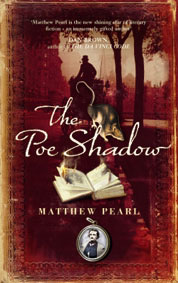
The Poe Shadow by Matthew Pearl


Believe it or not, a recent best-selling novel features C. August Dupin, the Rue Morgue, and the doppelganger motif. It's called The Poe Shadow by Matthew Pearl (author of The Dante Club and The Last Dickens).

You can read an excerpt here, or read the promotional description:

The body of Edgar Allan Poe has been buried in an unmarked grave. The public, the press, even Poe's own family and friends accept the conclusion that Poe was a second-rate writer who met a disgraceful end as a drunkard. But none of this deters a young Baltimore lawyer named Quentin Clark.

Quentin, an ardent admirer, discovers that Poe's last days are riddled with vital unanswered questions - that the police may be covering up. Just when Poe's death seems destined to remain a mystery, inspiration strikes - in the form of Poe's own stories. Quentin realizes he must find the one person who can solve the strange case of Poe's death: the real-life model for Poe's brilliant fictional detective character, C. Auguste Dupin, the hero of Poe's tales of crime and detection.

In short order, Quentin finds himself enmeshed in sinister machinations involving international political agents, a female assassin, the corrupt Baltimore slave trade and the lost secrets of Poe's final hours. With his own future hanging in the balance, Quentin Clark must turn master investigator himself to unchain his now imperiled fate from that of Poe.

Following his phenomenal New York Times bestselling debut novel, The Dante Club, Matthew Pearl has once again crossed pitch-perfect literary history with innovative mystery to create a beautifully detailed, ingeniously plotted tale of suspense that The Globe and Mail calls "a masterpiece," with which New York Times literary critic Janet Maslin says Pearl "has now created a two-book franchise on the cusp of mystery, literature and historical fiction." The Poe Shadow's groundbreaking research opens a new window on the truth behind Poe's demise, literary history's most persistent enigma, with documented material never published before. The resulting novel is a publishing event that "would make Poe himself proud" (Bookpage).


Monday, November 2, 2009

Setting: 19th Century Paris


Many American writers have set their stories -- mystery or otherwise -- in the French capital, perhaps due to its beauty and mystery, but also because it has been long recognized, along with London, as a world capital of the literary and visual arts. So, what did 19th century Paris look like? It's easy to find out since much of 19th century Paris is still with us today.

Here are some places mentioned in "The Murders in the Rue Morgue" (remember: rue means road or street in French; quartier means neighborhood; faubourg means suburb)

hotel in Faubourg St. Germain

Faubourg St. Germain
Located near the École des Beaux-Arts, this quarter is known for its artistry in general, and has many galleries along its rue Bonaparte and rue de Seine. In all, Saint-Germain-des-Prés is an upper-class bourgeois residential district, and its quality clothing and gastronomical street-side commerce is a direct reflection of this.

cafe on the Rue St. Denis

Rue St. Denis
One of the oldest streets in Paris, its route was first laid out in the 1st century by the Romans, and then extended to the north in the Middle Ages. From the Middle Ages to the present day, the street has become notorious as a place of prostitution. Its name derives from it being the historic route to Saint-Denis.


Rue de Richelieu
One of the longest streets in Paris, and for the first half of the nineteenth century, before Baron Hausmann redefined Paris with grand boulevards, it was one of the most fashionable streets of Paris. Today it is most notable for scattered coin dealers and currency changers, being near the stock market.

The First Modern Detective Story


fictional detectives -- how many can you name?

In addition to being a sly humorist, tomahawk literary critic, and master of the macabre, Edgar Allan Poe is also notably credited with inventing the modern detective story. The first fictional private detective is recognized as Poe's C. Auguste Dupin, introduced in 1841 with "The Murders in the Rue Morgue."

Poe shifted the focus of the mystery story from the description of shocking crimes and eerie setting to what Poe calls "ratiocination" -- using the powers of human observation, logic, and creative imagination, even putting himself in the mind of the criminal, in order to solve the mystery. Critic Brander Matthews wrote: "The true detective story as Poe conceived it is not in the mystery itself, but rather in the successive steps whereby the analytic observer is enabled to solve the problem that might be dismissed as beyond human elucidation."

Dupin was the prototype for the more famous male detectives who would capture the imagination of generations of readers. Each had his own set of personal eccentricities, but all shared in using a process of ratiocination. A partial list:

Sherlock Holmes, by Arthur Conan Doyle
Hercule Poirot, by Agatha Christie
Lord Peter Wimsey, by Dorothy Sayers
Father Brown, by G.K. Chesterton
Inspector Maigret, by Georges Simenon


"The Murders in the Rue Morgue" is also the most famous example of the mystery subgenre known as the locked room mystery, in which a murder victim is found inside an apparently sealed enclosure and the detective's challenge is to discover the murderer's modus operandi. Other famous locked room mysteries include Sherlock Holmes' "The Adventure of the Crooked Man," which bears many similarities to "The Murders in the Rue Morgue." Others include:

"The Oracle of the Dog" by G.K. Chesterton
"The King Is Dead" by Ellery Queen
The Mystery of the Yellow Room by Gaston Leroux
The Hollow Man by John Dickson Carr
And Then There Were None by Agatha Christie

Other Poe Stories You May Enjoy


Those who attended Giles Davies's one-man Poe show seemed to particularly enjoy the renditions of two of Poe's more humorous works: "Never Bet the Devil Your Head" (featuring Toby Dammit) and "The Angel of the Odd." These two stories are available online as follows:

Never Bet the Devil Your Head [ link to full text ]
A spoof of a morality tale: The narrator, presented as the author himself, is dismayed by literary critics saying that he has never written a moral tale. The narrator then begins telling the story of his friend Toby Dammit. Dammit is described as a man of many vices, presumably at least in part due to his left-handed mother flogging him with her left hand, considered improper. Dammit often made rhetorical bets, becoming fond of the expression "I'll bet the devil my head." Though the narrator tries to break Dammit of bad habits, he fails. Nevertheless, the two remain friends until they reach a covered bridge.

Now if you would prefer to watch the 20-minute movie from 2007, which looks either like an excellent production by high school students or a very cheap production from professionals.

Angel of the Odd [ link to full text ]
The story follows an unnamed narrator who reads a story about a man who died after accidentally sucking a needle down his throat. He rages at the gullibility of humanity for believing a hoax. He vows to never fall for such odd stories. Just then, a strange-looking creature made of a keg and wine bottles appears. The creature announces in a heavy accent that he is the Angel of the Odd - and that he is responsible for causing such strange events.

Tips to Understand Poe's Work


Reenactment of Poe's funeral on October 11, 2009

Here are some tips on understanding the themes, motifs, and style of Edgar Allan Poe. This should be a valuable resource for you when reading and writing about Poe. This may also provide some food-for-thought when it comes to writing your Poe essay, which will be fully assigned tomorrow.

Poe's depiction of death:

  • Death is not only inevitable, but it also can be beautiful, especially as it is portrayed in the poems.
  • Death can be horrific when someone realizes it is imminent.
  • Guilt, hatred, or revenge are appropriate justifications for murder.
  • Impending death can be postponed, but not always.
  • Death may actually enhance a loved one's beauty.

Poe's portrayal of love and beauty, especially in the poems:

  • Love is chosen by the individual, not determined merely by fate.
  • Love has historical, sometimes mythological, references.
  • Love has no boundaries, not even in death.
  • Beauty is only an idea, one that even death cannot weaken.
  • Beauty in its ideal form cannot be attained.

Poe's innovative and unusual use of words in both genres:

  • Words are frequently used for the way they sound, as well as for their meanings.
  • Poe's rhythm and internal rhyme becomes almost hypnotic in many poems.
  • The difficult vocabulary reflects the style of Poe's time period.
  • Every important word is intended to evoke a mood or atmosphere in the reader, and Poe aimed for the same effect regardless of whether the work was prose or poetry.

Poe's ability to instill fear in the reader, primarily in the short stories:

  • Poe builds suspense throughout the stories, revealing some facts while withholding others.
  • Because the element of danger is usually present, the reader can feel the intensity of the emotions.
  • The narration is frequently first person, which makes the reader's connection to the story more intimate.
  • Poe's descriptions are usually minutely detailed to give a sense of verisimilitude to the stories, despite their supernatural atmosphere.
  • The use of irony and black humor is common.
  • Gothic elements are usually prominent in his writing: the supernatural, evil animals, and dark, gloomy settings
  • Poe's depictions of how the human mind works heighten a reader's connection to the story.
  • The surprise endings provide a reason to go back through the work to look for clues missed on the first reading.

Saturday, October 31, 2009

Poe Show -- Please note


Those of you who are attending the Poe Show at the CSC, just a reminder: please show up in the lobby before 7:15, especially if I have your ticket. The doors of the theater close at 7:30, which mean we should be in the theater and seated before then.

Here are some rules of etiquette and tips for watching the play -- from the CSC:

It’s a great idea to brush up on theater etiquette to help everyone enjoy the experience. The following guidelines offer tips on what is expected of audience members.

Before the performance:

Buy your tickets in advance: In order to see a live performance, you first will need to buy a ticket. Your ticket will be for a specific date and show and is not refundable. You can, however, change the date for a small surcharge. Your tickets can be picked up at will call or purchased at the box office.

Dress comfortably: We want you to enjoy the live theater you’re about to see. Please dress comfortably, whatever that may be to you. Dress up or dress down; just be ready to see some great live theater!

Arrive a little early: Because you are attending a live performance, audience members may not be admitted if they arrive late. This avoids disturbing the performance for the actors and other audience members. Plan to arrive about 15 minutes early.

Take care of personal needs: Try to use the restroom before the show begins. Otherwise, if you leave your seat before intermission, you’ll most likely disturb other audience members and the performers.

Find your assigned seat: An usher will greet you before you enter the theater and ask for your ticket with its assigned seat number. When you sit in your assigned seat, you’ll help prevent confusion for other audience members. Once you’re settled, turn off your mobile phone so it does not disturb the performance or those seated around you if it rings.

Check out the program: The usher will give you a printed program. By arriving early, you’ll have enough time to read it and have an idea of what to expect in the show. You’ll also find names and information about people who are performing and helping to produce the show. It’s an enjoyable read—and sometimes surprising!

During the performance:

Listen closely: You will hear actors perform live for you, and careful listening will help keep you from missing important elements of the performance. Try to avoid talking or fidgeting during the performance. You'll be able to hear better and also avoid disturbing those around you.

Respond readily: During the live performance, feel free to let the actors know you appreciate the show. Laugh at funny parts, cheer when it’s called for, applaud when you like something, and even shriek when you’re frightened. We always appreciate a respectful, appropriate response.

After the performance:

Applaud enthusiastically: Show your appreciation by applauding for the performers. Occasionally, you might hear people applaud or cheer during the performance; that’s fine once in a while. But most often the audience holds its applause until after the performance has ended.

Remain seated for the curtain call: At the end of the performance there is usually a curtain call. This is when the actors come on stage to accept your appreciation. Wait to leave until the curtain call is over and exit with the rest of the audience.

Stand and applaud: Actors are thrilled when they receive what’s called a “standing ovation.” If you really liked the show and want to reward the performers with the highest praise, you’re welcome to stand and applaud.


Thursday, October 29, 2009

Doppelgängers in literature

Doppelganger in "William Wilson"


A Doppelganger ("double goer" in German) is a double or second-self. In literature, dream analysis, or archetypal symbolism, the Doppelganger is often figured as a twin, shadow, or mirror-image of the protagonist. The Doppelganger characteristically appears as identical to (or closely resembling) the protagonist; sometimes the protagonist and Doppelganger have the same name. Prominent literary examples of Doppelgangers include Poe's "William Wilson," Joseph Conrad's The Secret Sharer, Fyodor Dostoyevsky's The Double, Al-Tayyib Salih's Season of Migration to the North, and Ralph Ellison's Invisible Man.

In its simplest incarnation, mistaken identity is a classic trope used in literature, from Twelfth Night (as Jennifer & Larry will recall) to A Tale of Two Cities. But in these cases, the characters look similar for perfectly normal reasons, such as being siblings or simple coincidence. These are NOT doppelgangers.

Other stories offer supernatural explanations for doubles. These doppelgängers are typically, but not always, dark or evil in some way. The double will often impersonate the victim and go about ruining them, for instance through committing crimes or insulting the victim's friends (like in Dr. Jekyll & Mr. Hyde). Sometimes, the double even tries to kill the original. The torment is occasionally earned; for instance, in Edgar Allan Poe's short story William Wilson, the protagonist of questionable morality is dogged by his doppelgänger most tenaciously when his morals fail.

When doppelgängers are used as harbingers of impending destruction, they are almost always supernaturally based. Doppelgängers are sometimes the evil copies of the player in games. They are usually meant as 'the final test', conquering yourself. Another variant, usually seen in science fiction, involves clones, which creates a genetically identical new being without the memories and experiences of the original. Some futuristic variants in fiction duplicate living beings in their entirety, albeit sometimes with modified memories and motives.

Doubles are also seen in fiction involving time travel and parallel universes, as in The Time Traveller's Wife. In this case, the doppelgänger really "is" the doubled person, but from a different timeline or different version of the universe.

Trivia: Did you know that Abraham Lincoln was convinced he had a doppelganger? Carl Sandburg's biography contains the following:

A dream or illusion had haunted Lincoln at times through the winter. On the evening of his election he had thrown himself on one of the haircloth sofas at home, just after the first telegrams of November 6 had told him he was elected President, and looking into a bureau mirror across the room he saw himself full length, but with two faceIt bothered him; he got up; the illusion vanished; but when he lay down again there in the glass again were two faces, one paler than the other. He got up again, mixed in the election excitement, forgot about it; but it came back, and haunted him. He told his wife about it; she worried too. A few days later he tried it once more and the illusion of the two faces again registered to his eyes. But that was the last; the ghost since then wouldn't come back, he told his wife, who said it was a sign he would be elected to a second term, and the death pallor of one face meant he wouldn't live through his second term.


Wednesday, October 28, 2009

Adaptation of "The Masque of the Red Death"


Here is an interesting interpretation/adaptation of "The Masque of the Red Death." It's a highly abridged version, but the animator renders the masquerade quite nicely -- worthy of a look:

View: Masque of the Red Death animation

Masquerade Masks & Plague Masks


Masques for the Venetian carnevale festivities

Re "The Masque of the Red Death": The following is a brief summary of the most common masquerade mask types used during the plague years of the Renaissance in Italy.
Masks are an essential feature of il Carnevale di Venezia. Venice's Carnival began in the 11th century, and the wearing of masks and costumes was well established by 1436, when mask makers or mascereri were officially recognized with their own guild.

The practice of wearing masks for disguise reached its peak in the 18th century when Venetians of different social classes used Carnevale as an excuse to mingle among different classes of people without fear of recognition or retribution. The mask was always worn over a black hood with a black tricorn hat, along with a long black cape to give the maximum degree of disguise.

The volto masque

The volto mask completely hides the face. The moretta was a common type of volto -- an all black velvet mask made for women held in place by their teeth, which was supposed to add to their mysterious air. (The woman was supposed to charm the man without necessarily "talking.")

The bauta masque (spoon mask)

The traditional bauta mask allows the masquerader to eat and drink without removing it as it jets out from the face by several inches. It's also known as a "spoon mask" -- never mind a mouth on the mask. Worn all year round by the Venetian upper classes, the Bauta was the most popular of disguises during Carnevale.


The plague doctor masque

The plague doctor masque was said to protect the doctor from various diseases -- like Bubonic Plague -- since its very long nose doesn't exactly let you get too close to anyone's face.

Gallery of masques:

Tuesday, October 27, 2009

Snapshot: Novels with Unreliable Narrators


If any of you are particularly attracted to the literary idea of the unreliable narrator, some splendid American novels make use of one. Here are three:

One Flew Over a Cuckoo's Nest by Ken Kesey
"Chief" Bromden, a patient at a mental hospital, suffers from schizophrenia, and his telling of the events often includes things such as people growing or shrinking, walls oozing with slime, or the orderlies kidnapping and "curing" Santa Claus.

Flowers for Algernon by Daniel Keyes
Charlie Gordon, the narrator in Daniel Keyes' epistolary novel, Flowers for Algernon is mentally retarded at the start of the novel but develops greater intelligence and understanding as the novel progresses.

The Turn of the Screw by Henry James
Henry James' novella The Turn of the Screw, in which a young woman experiences ghostly hauntings summoned by supernaturally-powered children, can be interpreted as a novel of unreliable narration, but whether or not the narrator is actually delusional is left ambiguous. The young woman, a governess, tells stories of children being "threatened by the ghost of Quint," with the possible goal of misleading the reader into becoming a "victim of the governess's unreliable narration."

The Unreliable Narrator


The unreliable narrator is a distinct and important aspect of some of Poe's writings -- both his short stories and his poetry. Here's a good description from poewar.com:

An unreliable narrator is a first-person narrator that for some reason has a compromised point-of-view. In all stories with a first-person narrator, the narrator serves as a filter for the events. What the narrator does not know or observe cannot be explained to the reader. Usually, however, the reader trusts that the narrator is knowledgeable and truthful enough to give them an accurate representation of the story. In the case of an unreliable narrator (sometimes called a fallible narrator), the reader has reason not to trust what the narrator is saying.

The narrator may be unreliable for many reasons. Some of the typical scenarios are:

  • The narrator may be of a dramatically different age than the people in the story, such as a child attempting to explain adult actions
  • The narrator may have prejudices about race, class or gender
  • The narrator may have low intelligence
  • The narrator may suffer from hallucinations or dementia
  • The narrator may have a personality flaw such as pathological lying or narcissism
  • The narrator may be trying to make a point that is contrary to the actions of the story or be attempting to libel one of the characters due to a grudge

Whatever flaw the narrator has, at some point the reader will realize that the narrator’s interpretation of the events cannot be fully trusted and will begin to form their own opinions about the events and motivations within the story. Some readers will be put off by this approach. Stories depend on the willing suspension of disbelief, and readers can be pulled out of the story when they realize the narrator cannot be trusted. This is why telling a tale from this viewpoint can be problematic. There is a fine line between distrusting the narrator and distrusting the writer.

When done badly, a story written from this point-of-view can be viewed as manipulative, misleading, confusing and pretentious. When successful, however, the results can be powerful and fascinating.


Tell-Tale Heart -- Animation


Here's an animated version of "The Tell-tale Heart" from 1953 with James Mason narrating. You'll notice it's been shortened a bit -- the more graphic parts have been expurgated; unfortunately, one of the most important phrases (used twice in the story) has also been removed: "...a low, dull, quick sound, such as a watch makes when enveloped in cotton."

View the 7-minute animation

Monday, October 26, 2009

An Exploration of Poe Stories


Here's a highly recommended research website devoted to the works of Edgar Allan Poe.
Poestories.com
This site contains short stories and poems by Edgar Allan Poe, story summaries, quotes, and linked vocabulary words and definitions for educational reading. It also includes a short biography, a timeline of Poe's life, and links to other Poe sites.

Most people recognize Poe by his famous poem, "The Raven". Others may have read one of his more popular dark and creepy tales like, "The Fall of the House of Usher" or "The Tell-tale Heart". Poe wrote quite a few gothic stories about murder, revenge, torture, the plague, being buried alive, and insanity. Many modern books and movies have "borrowed" ideas from Poe. Some of Poe's stories were not well accepted in his day because people were just not ready for them- they were too scary.

Poe Show -- Update


I purchased tickets to the Poe show for everyone who gave me ticket money. We've got seats in Rows D and E. If anyone else is interested in going, you can still buy your own tickets. As of last Friday there were still seats available contiguous to our seats. Call the box office at 381-BARD.

Again, the show begins at 7:30 p.m. next Sunday, November 1st. The house lobby opens at 6:30 and the theater opens at 7:00. If you are not going with me, please meet us in the lobby of the theater between 7:00 and 7:15. If you need directions, please consult the CSC website.

Friday, October 23, 2009

M. Night Shyamalan & the Raven


For those who enjoyed The Village, you may be interested in checking out the director's official website. It is instructive to note that the icon/symbol M. Night Shyamalan uses on his website is the raven -- taken from Edgar Allan Poe's famous poem "The Raven" (Once upon a midnight dreary...)

Not coincidentally, the first work we'll be reading from Poe next week is "The Raven."

Thursday, October 22, 2009

The Village -- A Review


Now that you've seen the movie and had a bit of time to consider its themes, here's a balanced review from The National Review from 2004, at the time The Village was released in theaters. An excerpt:
The Village's greatest strength is a moral core that never devolves into moralistic propaganda.

Shyamalan poses questions about the human response to evil and loss then allows the audience to come its own conclusions. His themes are incredibly relevant to the dilemmas we face today: Should we confront the things that threaten us and try to defeat them, or should we retreat, sacrificing even truth if it is necessary to enjoy a precious, if tenuous, peace? Should we ignore real menaces we can't control in favor of imagined ones we can?

Shyamalan doesn't paint his villagers motivations as right or wrong, and his reticence to make an allegory of his tale may leave some viewers frustrated. But it will also leave them thinking more deeply about the issues than if they were force-fed a lesson. Already, critics are reviewing The Village through their own political lenses, and it is to Shyamalan's credit that both the left and right could make credible arguments that the film falls in their favor. [ read whole review ]

Your thoughts on the movie, its relevance to The Crucible and Irving's stories?

Wednesday, October 21, 2009

Crucible Test -- Key


For a limited time, I'm making available the answer key for the multiple choice section of the Crucible test in PDF form, so you can check your answers and see which ones you missed (if any).
That PDF is available by clicking here.
[Update: The answer key is now offline.]

At the same time, for something a bit offbeat (and silly), but still related, have a look at this:
The Crucible 3-Minute Cartoon

Or if you'd like to see Giles Correy say, "More weight!"
Giles Corey Death Scene

Tickets for Poe Show -- Sunday, November 1


We'll be having the high-school night out to see the new one-man Poe show at the Cincinnati Shakespeare Company on Race St. downtown on Sunday, November 1 at 7:30 p.m. Student tickets are $15 -- a great price! Adult tickets are $20.

You have two options to purchase tickets:
Option One: If you give me your ticket money by this Friday at 11:00 a.m. I'll buy them for you at the Box Office on Friday afternoon.

Option Two: You can purchase your tickets directly by phoning 513.381.BARD or online from the Cincinnati Shakespeare Company's website [here]
So, you want to know: What is a one-man Poe show. Actor Vincent Price was famous for his one-man Poe show presentations. Here are a few links to Price's renditions of Poe's works:
If you have any questions, you may leave them in the comments box!

Sunday, October 18, 2009

The One-Man Poe Show

After we finish The Crucible unit this week -- the end of the first quarter -- we will be taking a break from the Puritanism of 17th century Salem and turning to the American Gothic works of Edgar Allan Poe before we dive into The Scarlet Letter (also set in 17th century Salem). Late October seems to be a suitable time to study the "master of horror and suspense."

In order to supplement the Poe unit I'm going to organize a high-school night out to see the new one-man Poe show at the Cincinnati Shakespeare Company on Race St. downtown. I'm looking at Friday, October 30 and Sunday, November 1 as possible dates. The shows are at 7:30 on both days. Student tickets are $15 -- a great price!

Stay tuned for further information on how to obtain tickets. We're inquiring into getting a block of tickets for one of these nights; so, please let me know ASAP if any of you see any obvious scheduling conflicts for one night or the other.

Thursday, October 15, 2009

Usage Tip: Hark Back or Hearken Back?


Hark means to listen attentively, as in "Hark, the herald angels sing..."

Hark back is a related idiom, meaning "to return to a previous point, as in a narrative." (Myself, I prefer the synonymous idiom "givelendan ear," also written as "givelendone's ear.")

Hearken is nearly synonymous to hark, meaning "to make an effort to hear something." However, the idiom above does not synonymously translate into hearken back, though many mistakenly use "hearken back" rather than "hark back."

So, hark back -- or givelendone's ear!

Wednesday, October 14, 2009

Crucible -- Character Sketches


Here's an excellent resource that I highly recommend: The "Deeper Roots Project" provides helpful character sketches of Abigail, Reverend Hale, and Reverend Parris, using The Crucible movie for visual illustration. Having a look through these would be helpful for preparing for next week's test as well as for producing the play.
Abigail Williams -- part 1

Abigail Williams -- part 2

Reverend Hale -- part 1

Reverend Hale -- part 2

Reverend Samuel Parris
You may be able to find a few other episodes from the Deeper Roots Project.

Snapshots: American War Novels


A number of American novels dealing with the general theme of war would be suitable for the Three-Books Project. In addition to Heller's Catch 22 (already featured here), these three provide a unique look at Americans at war, the aftermath of war, and the sometimes-absurdity of war. You'll notice that each was written in a different decade in the 20th century.

Slaughterhouse Five (1969) by Kurt Vonnegut
Chaplain's Assistant Billy Pilgrim, an ill-trained American soldier, is captured by the Germans during the Battle of the Bulge and taken to a prison in Dresden. The Germans put Billy and his fellow prisoners in a disused slaughterhouse, known as "Slaughterhouse number 5." The POW's and German guards alike hide in a deep cellar; because of their safe hiding place, they are some of the few survivors of the city-destroying firestorm during the Bombing of Dresden in World War II. Billy has come "unstuck in time" and experiences past and future events out of sequence and repetitively. He is kidnapped by extraterrestrial aliens from the planet Tralfamadore. They exhibit him in a zoo with B-movie starlet Montana Wildhack as his mate. The Tralfamadorians, who can see in four dimensions, have already seen every instant of their lives. They believe in predestination. They say they cannot choose to change anything about their fates, but can choose to concentrate upon any moment in their lives, and Billy becomes convinced of the correctness of their theories. [ review ]

Johnny Got His Gun (1939) by Dalton Trumbo

Joe Bonham, a young American soldier, is hit by a mortar shell on the last day of World War I. He lies in a hospital bed in a fate worse than death --- a quadruple amputee who has lost his arms, legs, eyes, ears, mouth and nose. He remains conscious and able to think, thereby reliving his life through strange dreams and memories, unable to distinguish whether he is awake or dreaming. He remains frustrated by his situation, until one day when Joe discovers a unique way to communicate with his caregivers -- by banging his head on his pillow in Morse code. His wish is that he may be put in a glass box and tour the country, to show people the true horrors of war. As he drifts between reality and fantasy, he remembers his old life with his family and girlfriend, and reflects upon the myths and realities of war. He also forms a bond, of sorts, with a young nurse who senses his plight... [ review ]

The Caine Mutiny (1951) by Herman Wouk
Willie Keith, with a low opinion of the ways of the Navy, misses his ship when it leaves on a combat assignment, and rather than catch up with it, ducks his duties to play piano for an admiral who has taken a shine to him. But guilt-stricken by a last letter from his father, who has died of melanoma, he reports aboard the Caine. He immediately disapproves of its decaying condition and slovenly crew, which he attributes to a slackness of discipline by the ship's longtime captain, Lieutenant Commander William De Vriess. Willie's lackadaisical attitude toward what he considers menial and repetitive duties brings about a humiliating clash with De Vriess when Willie neglects a communications message. While Willie is still pouting over his punishment, De Vriess is relieved by Lieutenant Commander Philip Francis Queeg... [ review ]

Monday, October 12, 2009

Word of the Day: Somnambulism


Somnambulism: a condition that is characterized by walking while asleep or in a hypnotic trance; also known as: hypnobatia, noctambulism

If you're looking for an interesting and curious story to read in preparation for All Hallow's Eve, you might want to read "Somnambulism: A Fragment" by Charles Brockton Brown (1771-1810), a pioneer of the American novel.

Here's an excerpt from a review (explication) of the story:
Benjamin Franklin Made Me Do It!
In "Somnambulism: A Fragment" Charles Brockden Brown uses the gothic style to convey an unharnessed terror in a single vision: Young Althorpe, while sleepwalking in a forest, murders the woman he desires. But the story is more than a ludicrous curiosity, to read it thus would miss its elegantly stated manifesto against the dangers of Benjamin Franklin's megalomaniacal ideals of industry and pragmatism. The story exploits Franklin's example of the studious, dutiful, useful young man and turns him into a monster. Browns' mode of style is strategic, subversive, infiltrating the reader and earnest student of the eighteenth century by mixing the ordinary with the grotesque, the intelligent with the very wrong.

"Somnambulism scares because it is surrounded with the normal, because its central character, its killer, is not the usual deviant monster, but a sharp, educated young man, not very far removed from the ideals of Franklin himself. As a cue of his hunger to learn, his desire for accurate information, Althorpe uses an elevated language (example: "The family retired to sleep. My mind had been too powerfully excited to permit me to imitate their example.")...
read entire article...

Snapshot (+Reminder): Franny & Zooey by J.D. Salinger

Reminder: Please keep in mind that now, while your reading load is very light, you should be exploring potential books for your Three-Book Term project. You will need to have determined which books you will be reading and writing about by mid-second quarter. This research paper is a very significant part of the course.

In case you've forgotten, here's the intro sheet to the project:
Intro Sheet to Three-Books Project [ PDF ]

Meanwhile, I'll continue to present some snapshots of American works we won't be studying together during the year. This time on to J.D. Salinger's Franny and Zooey. Here's an excerpt from a seminal review in The New York Times by John Updike in 1961:

...and now "Franny" and "Zooey" have a book to themselves. These two stories--the first medium-short, the second novella- length--are contiguous in time, and have as their common subject Franny's spiritual crisis.

In the first story, she arrives by train from a Smith-like college to spend the week-end of the Yale game at what must be Princeton. She and her date, Lane Coutell, go to a restaurant where it develops that she is not only unenthusiastic but downright ill. She attempts to explain herself while her friend brags about a superbly obnoxious term paper and eats frogs' legs. Finally, she faints, and is last seen lying in the manager's office silently praying at the ceiling.

In the second story, Franny has returned to her home, a large apartment in the East Seventies. It is the Monday following her unhappy Saturday. Only Franny's mother, Bessie, and her youngest brother, Zooey, are home. While Franny lies sleeplessly on the living-room sofa, her mother communicates, in an interminably rendered conversation, her concern and affection to Zooey, who then, after an even longer conversation with Franny, manages to gather from the haunted atmosphere of the apartment the crucial word of consolation. Franny, "as if all of what little or much wisdom there is in the world were suddenly hers," smiles at the ceiling and falls asleep.

read the entire review...